I know what you’re all thinking. How could I possibly promote a closet organizer designed by an ex-convict? Let me tell you a secret: there is no other way.
Not in my life, and perhaps not in yours. No other options exist. If you are living out of a shoe closet or bunking in someone’s pantry, you really are at the mercy of whatever life throws your way. In fact, you will probably be overjoyed to receive anything at all. So this piece of wisdom I offer to you: when it comes to the world of small space habitation, vertical livingis the key.
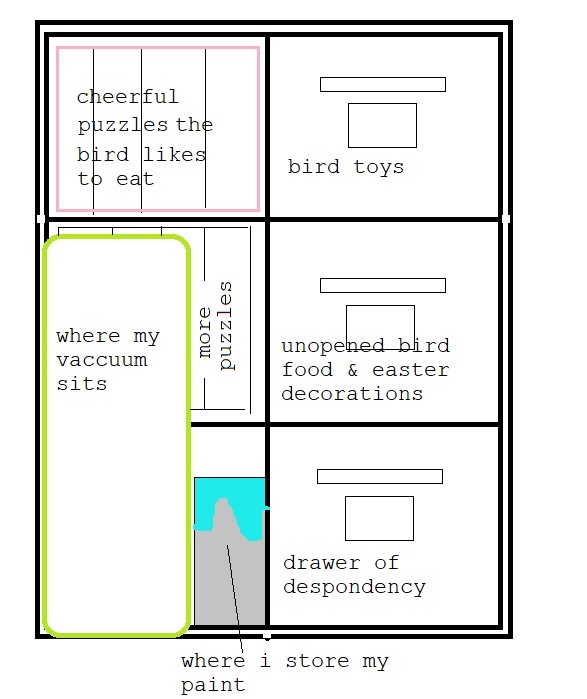
Around the time that China was building islands in the South China Sea, I was wandering lonely as a cloud through Home Depot. Overwhelmed by the variety and volume of home organization decor, I grabbed the closest item in a sheer panic and ran. When I got home I discovered it was a six-cubed Martha Stewart Living home organizer. Curiously, I’d also taken several collapsible fabric bins, which upon closer inspection fit perfectly in the compartments.
Unfortunately I can’t say much for the colour selection of Martha’s designs, but I’m sure it’s tricky designing things online when you have other inmates impatiently awaiting their 15-minute internet slot.
Seriously, this is ugly right? Green is okay; beige is okay; but there’s a TIME AND A PLACE FOR BOTH
Luckily for me, the organizer only fits in my closet. Which I keep closed. Always. As you can see, I have utilized every compartment to its maximum potential:
My belongings are my birds’ belongings; therefore my belongings are merely expensive bird toys
Unfortunately you can see the lack of space creates some organizational issues, but I am a person who loves challenges.
This photo is purely decorative – imagine how boring the shelf of a fridge would actually look.
shelves are all they’re cracked up to be
We have come a long way as a species, from hoarding our perishables in the dirt for refrigeration purposes, to actually using refrigerators. And it’s not just our food that needs to be kept cold: it’s the food of pretty well all of your animal companions. Bird seeds in themselves have a three-month lifespan, provided they are kept refrigerated, and bird pellets have a six-week time limit once they are opened (check out Harrison’s Bird Foods to find out why seeds need to be ditched and pellets are the best choice).
With everything you’re juggling (such as filing taxes in a timely manner or wine-making in your bathtub) dates need to be kept track of and bird foods need to be labelled. If you don’t have a sharpie, you should invest in one; I highly recommend it. And while you are still nosing about in your fridge –
utilizE the secret compartments in your fridge to your advantage
My fridge is, quite conceivably, older than I am. Judging by its appearance, it was birthed off its factory conveyor belt sometime between 1981 and 1983. Not only does that show you that things were indeed built to last, it also explains some of the challenges I experience with refrigeration (not with fridges in general, just this one. I’m not that daft). When I moved into my apartment – circa 2010 – the fridge that awaited me only had one shelf, although it was obvious it had contained at least four in the prime of its life.
Not only did I have to scavenge a secondary shelf from a conveniently discarded refrigerator by the dumpster out back, but I also had to rig up a method of supporting this shelf. It still sits to this day hooked onto a piece of plastic on the inner back wall, supported by two bottles on either side: Nonna Pia’s Balsamic Reduction (highly recommended), and Crown’s Golden Corn Syrup (expired in October 2019 but still good as far as I can tell).
Given the lack of convenience this fridge routinely offers, I was not surprised when I discovered that this one came with not a dozen, but ten built-in egg-holders. Now, you might say that all fridges are made this way, but I choose to blame it on my make and model, and the sheer weight of age it carries with it. Needless to say, I refuse to put my eggs in a container where not all of them will be held and where I still have to leave a carton of two on the shelf regardless. The very thought of subjecting myself to its inconvenience offends me.
So as you may have guessed my egg-holders lie empty. Well, mostly: they have been great for storing tubes of crazy glue and the odd lemon, and now, bottles of bird medicine. If you’ve never seen one of these, they are tiny. Think of a teensy-weensy bottle of essential oil, the ones you pay $12 for. That size. Except in my case I pay anywhere from $40 to $60CAD as the contents are somewhat more legit, and prescribed by actual doctors.
Seeing as you’ve paid a hefty amount for your 3mL bird prescription, you’ll want to be making sure you don’t lose a drop. Egg-holders will do that for you, and more! Being located in the fridge, they will also keep those KEEP REFRIGERATED bottles cold. But best to double-check with your (qualified) (avian) veterinarian before making that call, as not all medications require it.
As a disclaimer, you should know that letting ducks onto your counter tops is an invitation for trouble. As quaint as it may seem, it is a mistake unless you live in a barn. A duck’s clumsy nature combined with their already low clearance is a deadly combination – their direct radius of havoc is about as wide as their wingspan, and theturbulence resulting from a gentle stretching of their wings is comparable to the rotor wash of a helicopter. So keep this in mind when introducing your house to your duck: best keep it to the floors (or couch, if you are watching TV together).
With that in mind, the things you place on your counters are of importance when it comes to running a house of various birds, mammals, or reptiles. With the trending of tiny homes, it is a matter of necessity that you sort your priorities. Space isn’t cheap for most of us, and living in a miniature world is the reality for plenty of people, whether it be by choice or mere misfortune. We need to make the most of what we have.
As someone who has little storage space or surface area, I need to make sure the things I value the most are nearby and ready: in this case, bird supplies. As you know, I weigh each bird several times a week, and two to three times a day I may have to administer medication. This grueling task can only be made easier by a strict code of order and organization. Without it I would have lost marble a long time ago.
I’ve taken the liberty of drafting out a not-to-scale rendition of my bathroom counter, for ease of explanation.
A clean counter is a clean mind, as a famous person once said
Thank heavens I consider this strict organization. If it became any more lax than this, I would be eating off the floor – simply for lack of space. And as we all know, one can’t be a proud bird parent while dining on the kitchen tiles; it just won’t do.
my foray into the adult world of prized possessions
If I haven’t made it clear already, any kind of poop on a wooden or otherwise antique creation, is an atrocity and a crime. The decent thing to do would be 1) give the furniture up for adoption to a safer home, or 2) cover it with layers of indestructible, impenetrable materials that create a sufficient protective layer so as to preserve the unique qualities your antique undoubtedly possesses.
First off let’s be clear: never punish a bird for destroying your precious possessions: it was your fault your valuables were left out, or left unattended, or not kept bolted down. I mean really, you were asking for it the moment you brought your bird home. So the least you can do is batten down the hatches and fortify your bases.
Are the giant art pieces on your wall getting their frames shredded by happy beaks? My step-dad solved this problem by taping down tiny cat food tins along the tops of paintings so that no bird could alight. This was a method similar to the pokey bits installed on top of streetlamps in an attempt to dissuade determined seagulls from settling in, or the awkward lumps on public benches to make a night’s sleep that much more uninviting (let’s be real – we’re still going to do it, we just won’t be comfortable).
In this wood-shredding instance, the tins on the painting in our kitchen added a certain edgyquality to the already unconventional vibe that came with the piece. They say beauty is in the eye of the beholder, but it can also be said that art is in the eye of its creator.
Now this antique sewing-machine-in-a-table from my step-dad’s mother (circa 1940), lives with me in a very small space. As I do not have the capacity for tables which are simply antiques and tables that support my birdcages, I have meshed the two: art meets function. Given the age and value of this delicate creation, I have taken these crucial steps to protect its value and worth:
An ounce of planning is worth a penny of rest, as a famous person once said
The materials need not be costly, as you can see, but just good-looking enough to not stand out. If I’d had the choice, I would not have gone with blue as the bag colour, but we are not all afforded such options. Happy crafting!
Considering how excited these little beans get over houseplant soil, it’s disappointing to have to ruin their fun. It’s a struggle as I want my little ones to be free to follow their hearts’ desires, but I have to draw the line at eating dirt and other similar items that belong in the garbage. We may think our domesticated companions know what’s best for themselves, but the truth is they are so far removed from their wild ancestors, that they would not survive were they to return to the plains of Africa (Banana), the warm climes of the Canaries (Red), the nomadic flocks of Australia (Sky and Yellow), or the arid western coastline of Timor (Puff and Tweedle).
Soil is teeming with fungal spores and bacterial colonies, not to mention toxic fertilizers – none of which should be living in our birds – so it is with a great amount of urgency that I vault across the room when I hear the distinct and unmistakable sound of a beak masticating vermiculite. To make matters worse, I discovered that not only is Banana a hazard to himself, he also offers lessons to the budgies on the finer aspects of soil selection. I can’t be angry, because everyone knows that idle beaks are the devil’s playground, so I need to ensure that all beaks are occupied with appropriate and approved bird-safe items, even if we do disagree on the definitions of those words.
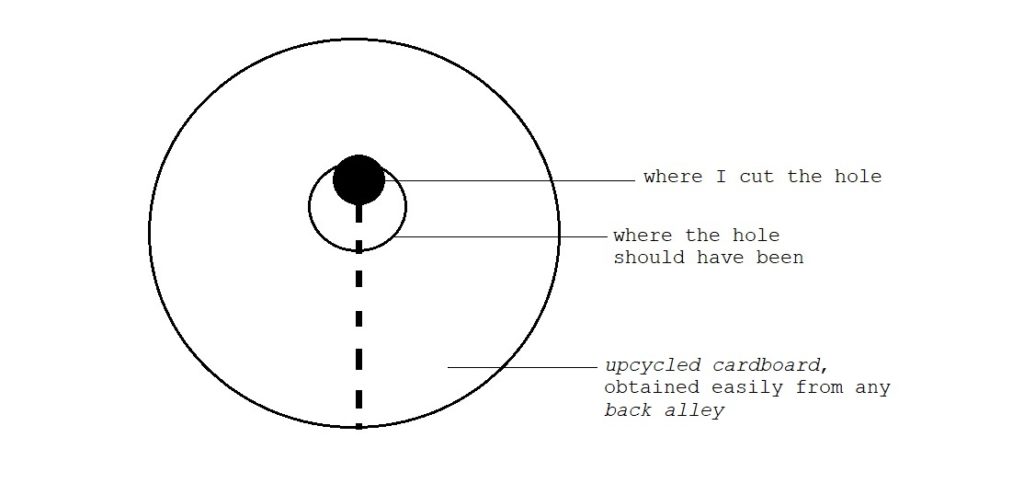
In a desperate attempt at foiling these beaks, I have tried: a) dish towels (so shabby I could hear my property value drop), b) newspapers (those snippy snappers ate right through the editorials into the dirt) and c) bird skirts (merely inconvenient). But shortly after the newspaper debacle I discovered that cardboard had been invented years before (an embarrassing oversight on my part). The results were low-effort but high-function, contrary to all my previous endeavours. My rendition of the design is as follows:
This is just what I did. You might want to measure where the middle of the plant is so you don’t get something like this. But because I’m lazy I just carved a bigger and less attractive hole to fit where the actual plant was. So you basically just make the outer circle as big as your pot… and I’m pretty sure the rest is straightforward.
Don’t forget to cut a line in the cardboard so you can get it around the plant , and poke some holes in it to promote air flow (one doesn’t want to encourage vicious swarms of fungus gnats to set up shop, which some would argue are as difficult to eject as hippies taking up long-term residence upon one’s couch. Which reminds me of a joke I heard: How do you know if a hippie has been to your house? They’re still there. Much like the fungus gnat).
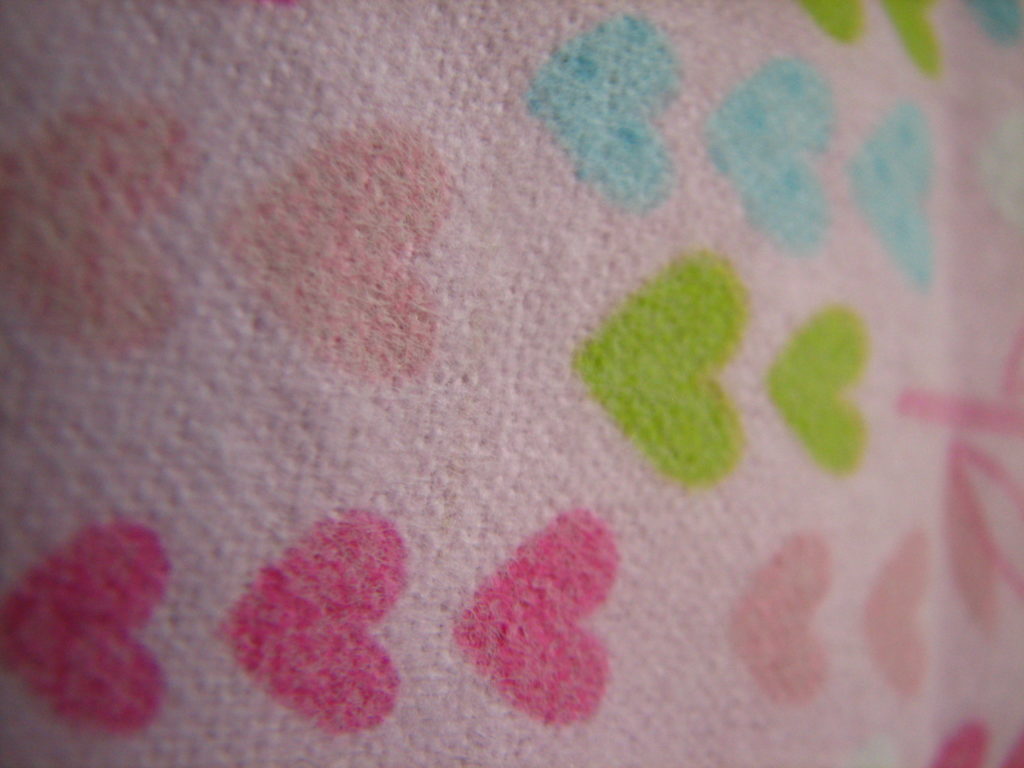
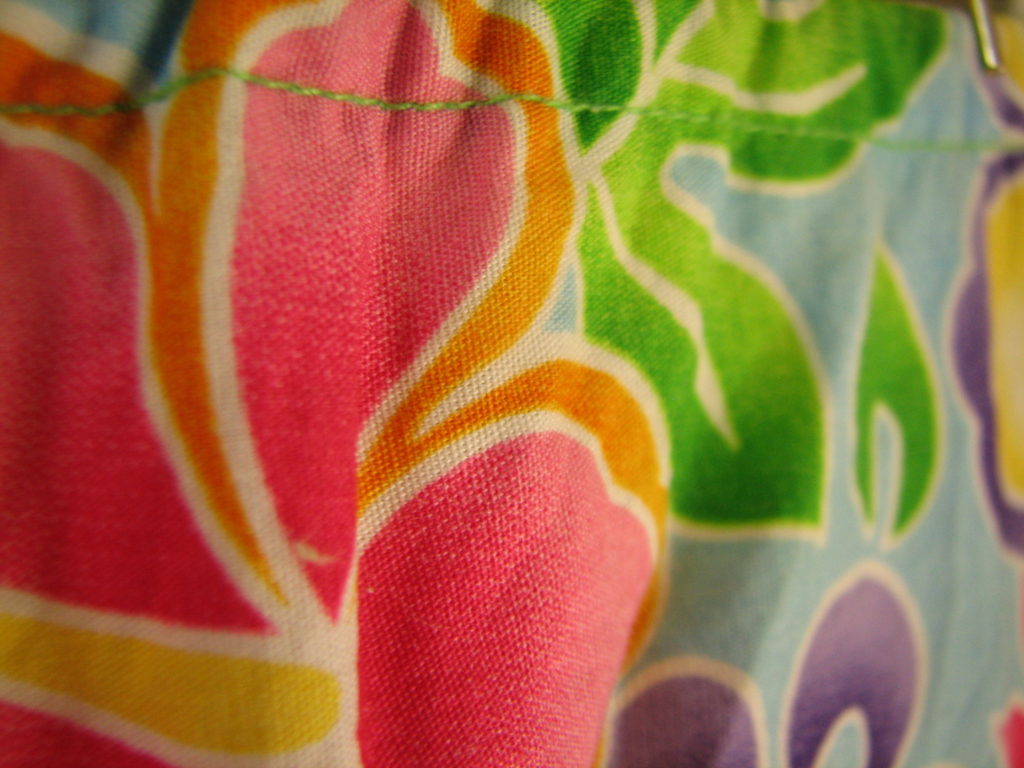
Maybe next week I will have a prettier version, if I find time to play around with it. Some cute fabric might look nice glued over the hideous brown of the cardboard. If you do decide to experiment, just remember to use non-toxic Elmer’s glue, and hide the unfinished seams of your fabric on the underside of the cardboard so no one eats threads.
Free being the operative word here. As I have mentioned before, I am a rather thrifty person (at least when it comes toantiques, or bus fare, or finding food), so I never would have just gone out willy-nilly, nor would I havesimply purchased sheetson my own. That is just too much forethought and concentration for someone already running on limited resources. Up until this February, I’d spent the preceding decade getting ready for bed by picking dried bird poop off my pillows, which – to be honest – is a somewhat unnerving affair. Even for the seasoned birder who doesn’t recoil in horror when faced with bird excrement – figuratively or literally – when said poops are in one’s personal sans-clothing environment, it is somewhat disquieting. We’re civilized people.
For the ten years that I had been laying my head to rest on befouled linens, my sister had been enjoying the comforts of regularly laundered bedclothes. Neither of us knew that our lucks would soon reverse, as Holly the rooster entered her life, and sullied bedsheets departed mine. With Holly, the need for sheets became critical in order to fully impede the wake of debris that trailed behind him. The Gallus gallus domesticus may be a refined creature who prides themselves on maintaining elegant plumage at all times, but aware they are not when it comes to stepping in their own poopies and then tracking them around the house.
Of course, this was not discovered until the unfortunate events had already occurred, but by this time I was the obliviously happy owner of a free bedsheet courtesy of my sister. The day I got it was the day I said hello to clean pillows (well, let’s be honest, I forget to cover them all the time, so theoretically, I am no longer picking poop off my pillows. But that’s good enough for me).
Hello. If you have come this far, I love you. Now, if this is the first you’ve heard of such things, don’t be alarmed: cages have been wearing skirts for quite some time. It goes at least as far back as the invention of birds; from the moment our ancestors first captured wild canaries to decorate their caves (only to discover the surprisingly wide radius spray of bird-seed and feathers), we have been desperately experimenting with all sorts of methods of containment.
At first it was likely a crude design of rather large leaves, later developing along with the Bronze, Iron and Middle Ages through until cages were invented, somewhere in the Early modern period. Having a cage was arguably one of the greatest steps toward tidiness, but as we soon discovered there were some holes in our design. Literally.
The original texts are probably lost, but we can surely attribute the creation of the cage skirt to some bright spark who, tasked with hemming the robe of Queen Elizabeth I, accidentally affixed a bodice to a ruff, thereby creating what came to be known as the first petticoat for bird cages.
Against all odds, this innovation survived the next four centuries – arriving in the 21st century with a vast array of fashionable colours, styles, and materials to house the contemporary bird.
This device, having been shunted into the modern-day mainstream (if you can call birding mainstream), brings with it a number of material improvements (think less crushed velvet and more light cottons), and fashion solutions (think hoopskirt meets tube top).
If you’re in the Vancouver area, check out West Coast Tropical Bird Studio (wctropicalbird.com). If you are offended by Hawaiian print, you can make your own quite easily (I imagine. It looks easy). As well as colour-coordinating your birdlings’ abodes and adding a certain je ne sais quoi to your room, their second function – keeping bird food contained – is not 100% (I’m not gonna lie), but the bulk of their pellets are prevented from launching too far afield.
As well as keeping my social life on track, my calendar keeps egg production recorded (not mine) so I can tell the doctor (not mine) what she needs to know in order to treat my finches. Tweedle and Puff have a cunning habit of getting riled up when it’s egg-laying season – which, as it turns out, is any day of the year – and when they do, I need to record how many they’re popping out.
While I spend my time running around weighing them and charting their production, the girls are eagerly plotting their next clutch. I initially thought it was charming and rather cute, but there’s nothing like a brisk 72 km drive and several hundred dollars in emergency bills to set things straight. I call it a learning experience. Some just cost more than others.
There’s also nothing worse than taking your birdling to the vet only to be told it’s gained five grams and is now obese. If we had weighed our birds, this would not be happening. Not only is it embarrassing, it’s bad for the bird. Their poor little organs (never mind their legs) have trouble functioning with the added poundage. Imagine a watermelon on toothpicks. Doesn’t look comfy, does it?
Neither is a thin bird good – you may not know it, but weight loss is the first sign your birdlet is sick. They like to keep these things to themselves, as they don’t want to worry you or look like a tempting snack. There is a reason the slowest in the herd get picked out, and they don’t want to go the way of the lame zebra, or gazelle, or emu. It’s really about self-preservation. So you must be as wily as they are and break out the kitchen scale every so often, because grams don’t lie.